
ESG reporting a small business can actually do
No consultants and no sustainability team. HR Edge takes you from a first assessment to a plan, a carbon footprint and a report you can share, inside the HR platform you already use.

Small businesses are being asked about ESG
ESG questions now reach small firms through the people they work with. You may have no duty to publish anything, but you are increasingly likely to be asked.
Larger customers
Supplier questionnaires ask about your carbon, your people and how the business is run.
Tenders and public-sector bids
Many bids include questions on environmental and social practice, and evidence helps your answers stand up.
Lenders and insurers
They want to understand your risks, including climate, governance and how you look after people.
Staff and job candidates
People want to work for an employer whose values they share, and they ask about them.
Eight tools that take you from "where do we start?" to a report
Evidence-based assessment
Work through 20 topics and 71 evidence checks. Your maturity is calculated from what you can show, not from a guess.
Stakeholder register and survey
Record who matters to your business and how much influence they have, then survey them on the issues they care about.
Materiality matrix
See every topic plotted by how much it matters against how well you manage it, so the critical gaps stand out.
Sector benchmark
Compare your environmental, social and governance scores with indicative ranges for small businesses in your sector.
Carbon footprint calculator
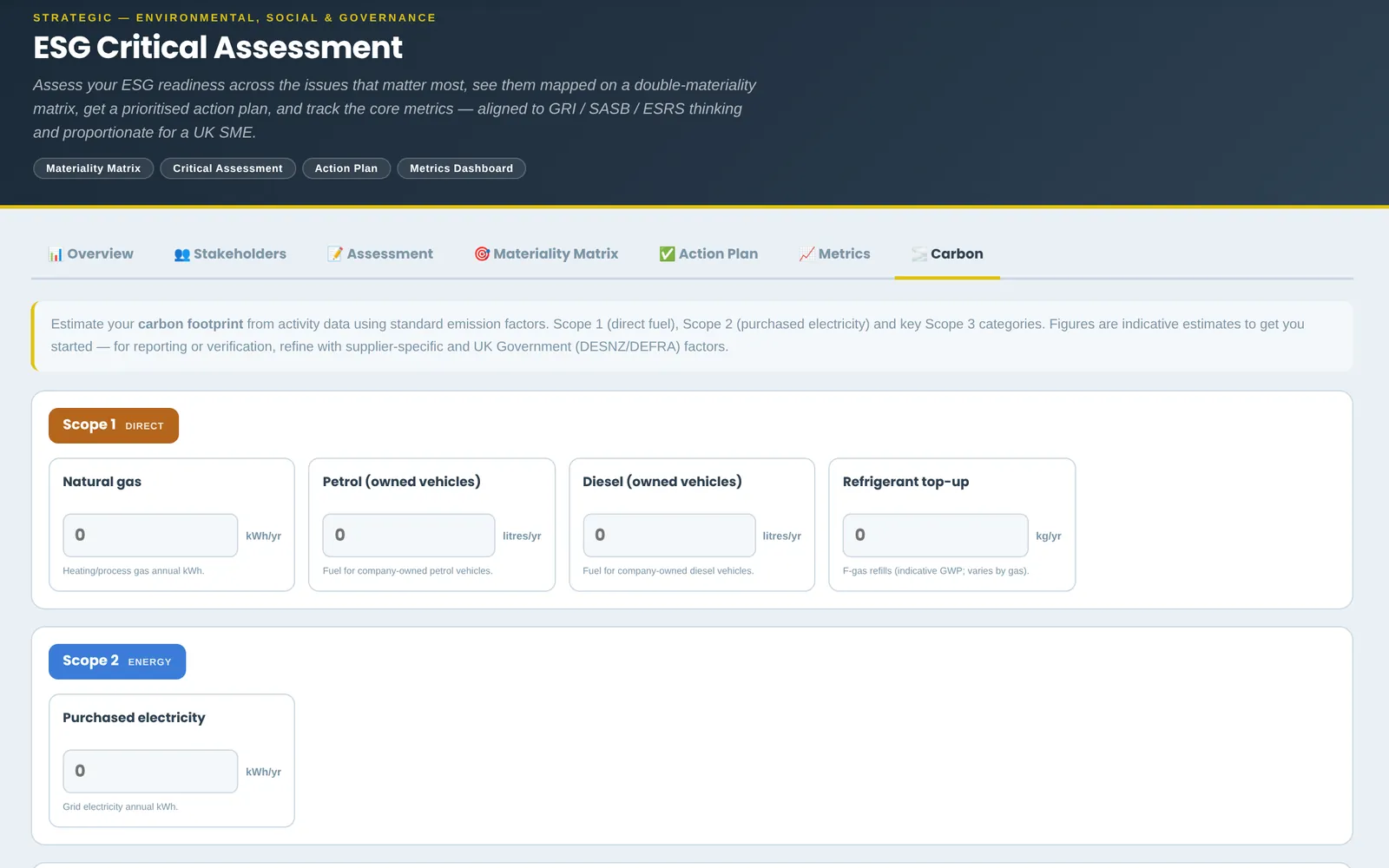
Turn energy, fuel, travel, waste and water figures into a Scope 1, 2 and 3 estimate, with a reduction plan.
Prioritised action plan
Gaps are ranked for you, most important and least developed first. Tick them off as you go.
Core ESG metrics
Track 12 core measures against your own targets, see what is on track, and get a written commentary for your board.
Reports and progress history
Produce a full ESG report or a framework-aligned disclosure document, and save snapshots to show progress over time.

How it works in four steps
The free ESG Guide walks you through the same route, with each step linked to the tool that does it.
Assess where you stand
Map your stakeholders, then record the evidence for each topic. HR Edge works out your maturity from it.
Tool: Stakeholders, AssessmentChoose what matters
Rate how material each topic is to your business and stakeholders. The matrix shows which gaps to tackle first.
Tool: Materiality MatrixAct and measure
Work through the prioritised action plan, track your core metrics and estimate your carbon footprint.
Tool: Action Plan, ESG Metrics, Carbon FootprintReport and show progress
Produce a report or disclosure document to share, and save a snapshot each time you reassess.
Tool: ESG Overview
Proportionate, evidence-based and priced flat
ESG frameworks were written with large companies in mind. We built the suite so a business without a sustainability team can use them sensibly. And because fair pay, health and safety, training and ethics are people topics, your ESG work sits alongside the HR tools you already use.
- In proportion. You decide how material each topic is and mark what doesn't apply, and your score is weighted to match.
- Scored on evidence. Each topic's maturity is calculated from the evidence checks you meet, rather than a self-rated dial. Any manual override is clearly flagged.
- UK emission factors. The carbon calculator uses indicative UK factors, and tells you when to refine them for formal reporting.
- Recognised frameworks. The disclosure document is aligned to GRI, SASB, ESRS and UK SRS.
- One flat price. Included in Premium at £99 a month, with no per-employee fees and no extra charge for ESG.
See a complete assessment, worked through
Pennine Precision Components Ltd is a fictional manufacturer of about 85 people in West Yorkshire. We created it to show what a finished assessment looks like, with notes explaining every rating.
Its stakeholder map shows why supply-chain topics matter so much: its larger customers ask about emissions and responsible sourcing in tenders. So the action plan puts supply-chain ESG and a first carbon footprint at the top. A second fictional example, a professional services firm, shows how the priorities change with the type of business.

Every ESG topic that matters to a small business, in proportion
The assessment covers environmental, social and governance topics, each with three to five evidence checks. You decide how much each topic matters to your business, and mark any that don't apply as not applicable.
Environmental
6 topicsYour impact on the planet, and how environmental change affects you.
- Greenhouse gas emissions
- Energy use and efficiency
- Waste and circularity
- Water use
- Sustainable sourcing
- Climate risk and resilience
Social
8 topicsHow you treat your people and the communities you touch.
- Diversity, equity and inclusion
- Health and safety
- Employee wellbeing and engagement
- Training and development
- Fair pay and equity
- Human rights and labour (supply chain)
- Community and social impact
- Data privacy and customer care
Governance
6 topicsHow the business is led, controlled and held to account.
- Board and leadership oversight
- Business ethics and anti-corruption
- Risk management
- Legal and regulatory compliance
- Transparency and reporting
- Cyber security and IT governance
Your overall score is weighted by how much each topic matters to you, and topics marked not applicable are left out, so a small office business isn't marked down for issues that belong to a factory.
ESG questions
Do I need ESG if I'm not a big company?
Most UK small businesses have no legal duty to publish an ESG report. But larger customers, tenders, lenders and insurers increasingly ask suppliers about their environmental, social and governance practices. With an assessment and a report ready, you can answer with evidence instead of starting from scratch each time.
Which plan includes it?
The full ESG suite is part of Premium, at £99 a month with no per-employee fees. The ESG Guide, a plain-English introduction to ESG for small businesses, is free to read on every plan. See Premium.
Can I export a report for a customer or tender?
Yes. From the ESG Overview you can produce a full ESG report, or a disclosure document aligned to GRI, SASB, ESRS and UK SRS. You can copy it, download it or print it to PDF. Both are drafted with AI from your own assessment, so read them through before you send them.
Does it calculate our carbon footprint?
Yes, as an estimate. Enter activity data such as gas and electricity use, vehicle fuel, business travel, waste and water, and the calculator works out your Scope 1, 2 and 3 emissions using indicative UK emission factors. It can then draft a carbon summary and reduction plan. For formal reporting or verification, refine the figures with supplier-specific and UK Government factors.
Is it a certification?
No. HR Edge is an assessment and reporting tool. It helps you see where you stand, decide what to do and report on it, but it doesn't certify or audit your business. The disclosure document is self-prepared and aligned to recognised frameworks, not certified against them.
Answer the next ESG question with evidence
The ESG suite is part of Premium at £99 a month, alongside board reporting and the HR Maturity Scorecard. No per-employee fees.